Present
Integration of expertise areas in Final Bachelor Project
Business & Entrepreneurship
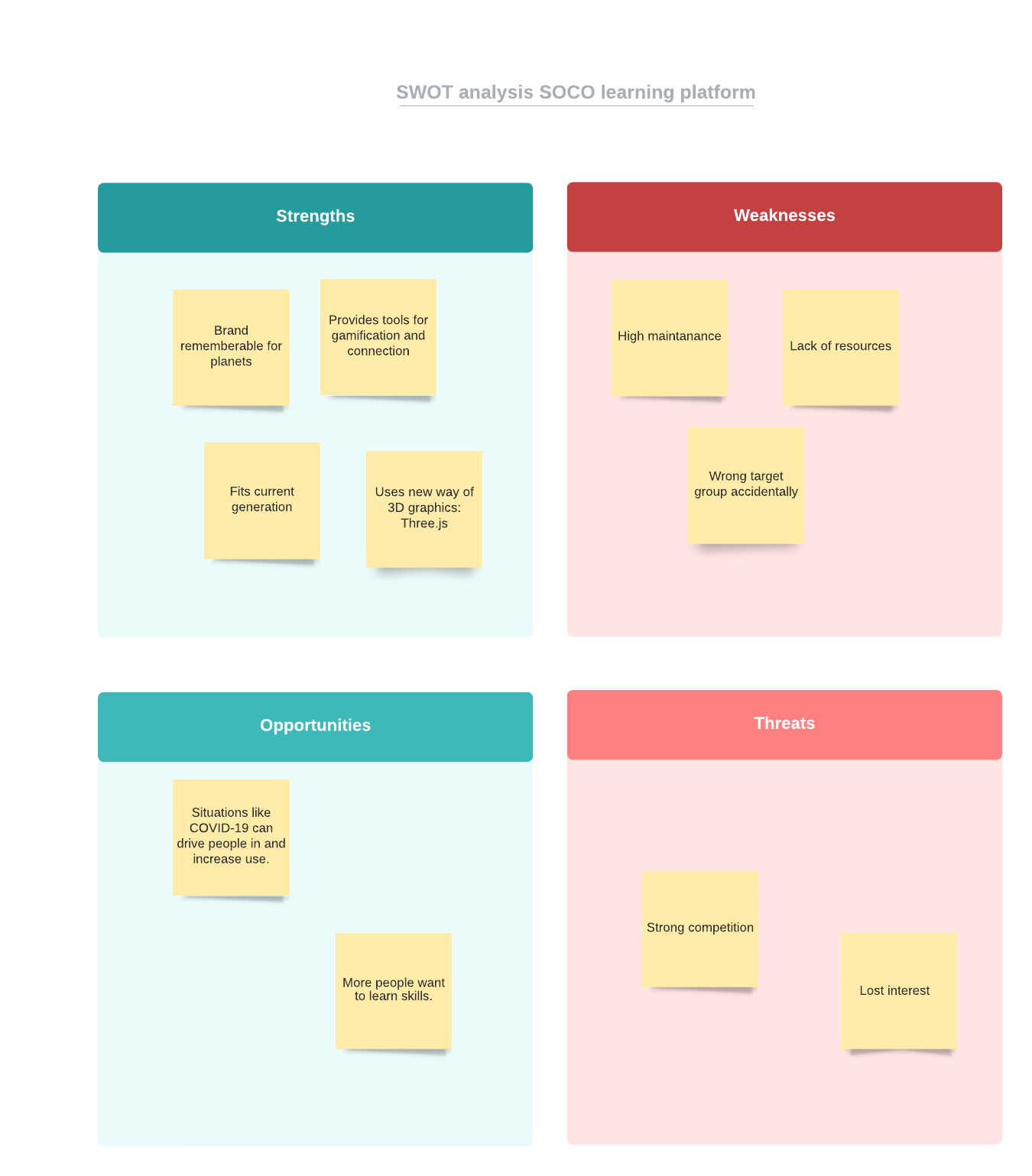
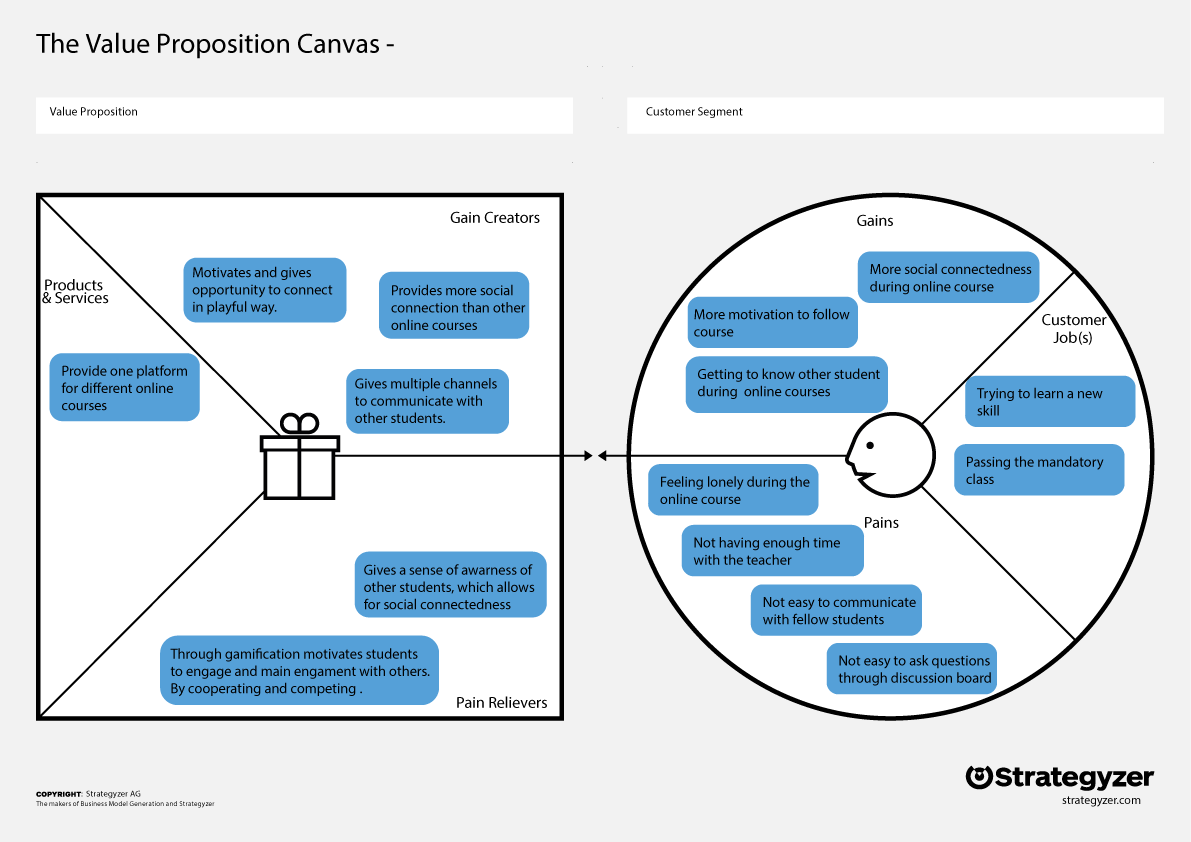
In my Final Bachelor Project, the expertise of Business & Entrepreneurship can be seen by examining the business case. These parts were al identified in my project. In addition, tools such as the value proposition canvas and SWOT analysis were made to aid in examining the designs position in business(See figures below).
Opportunity:
With the recent COVID-19 outbreak that has affected university students in an increase of social isolation. The use of technology has decreased the need for direct communication with each other. This resulted in people expressing mostly negative experiences during this period. Many suggest that attention should be on social and psychological support. Academic institutions typically take proactive measures to limit the effect of social isolation and encourage social integration. Furthermore, when looking at research in this field, most of them focus on fostering social connections. This has been done with play in mind but mostly in shared spaces. Therefore, I wanted to focus on creating a playful solution that would apply in situations such as where social distance is required.
Problem description:
The COVID-19 has led to an increase in use of online learning. Studies have shown that this resulted in students having an increase of social isolation. This can lead to mental problems; this implies health & economic consequences for society. Furthermore, more situations where for long periods of time people need to keep distance might occur again and might have impact on the whole society.
Solution:
My solution to the problem is an online learning platform for students that create and maintain social connections.
How will it work:
It will make use of gamification. Applying game concepts to interactions is often used to create motivation.
Risk:
The gamification could lead to taking away from the learning. Other competitors dominate the market too much.
Risk Mitigation:
The quality of the content should be engaging by itself without the game elements.
Complexity:
The project design is a complex platform for online learning. Many technical functionalities must be considered (data security,3D graphic interactions, page interactions) and graphical decisions( page design, 3D design).It will require multiple resources from different fields.
SWOT analysis and Value proposition:
Creativity & Aesthetics
The gamification element of using 3D interaction and point systems, is the core of the platform to fulfill the project goal, to motivate and promote social connectedness.
The process of creating the game element which motivates students within the platform, required creativity to be made. The concept of the game element is as follows: At the beginning of the course the student is assigned to a study group of max 4 person. Each group is given a bare 3D planet at the start of the course. Individually earn points for their group throughout the course to customize their planet.
The idea of 3D planets was inspired from the activity in multiplayer games of guilds creating and decorating guild houses. This is an example of a cooperative activity that requires social connection to do. However, using houses as object to interact with, is not relatable for many people. I did some further research and came across the social experiment of r/place. This experiment had people collaborate to create art on a blank virtual canvas. This inspired me to choose a universally relatable object for my game element: Intuitively the idea of a planet came to me. After thinking about it I concluded that it would really relate with people. The first feedback about it were very positive. I decided to continue with this idea.
The layout of the webpages of the online platform in the project was based on current already known online learning platforms. My own changes were added with the intent to improve usability and visual appeal. This was validated with students, and after their feedback it was adapted. My criteria for color were: 1) It had to calm colors and 2) it had to fit the theme of academics.
Math, Data and Computing
In the concept there are two parts which especially involve the use of user data. In the point system students would receive points for solving homework/quizzes and discussion board topics. The more activity & difficult these were, the more points they should receive.
In order to achieve this more knowledge about handling data was necessary. To store the data and handle it other coding languages and knowledge have to be used, such as SQL. This is the standard language for relational database management systems. Furthermore, the data would need to be tracked as input into the database and analyzed using algorithms to analyze the data; software for tracking activity can be used. Depending on the software used, different user input can be tracked. For example, clicks and time on a specific area of the webpages. The software can then use their build in algorithms to interpret and visualize this data for you. An example of tracking software is: HotJar, this can track and interpret user behavior for your pages. We can use software to save resources instead of creating it in addition to the platform.
Technology and Realization
While creating a prototype for demonstrating the concept several technical considerations had to be made. The concept was complex and consisted of multiple elements that had to be demonstrated. The whole final product was an online platform. This meant that the interactions as a website was important to be shown. Using sketches, more drawings or wireframes was considered. This would mimic the interactions and show the visuals, however I also wanted to show the technical feasibility of the design. Therefore, I went to creating and styling the platform with code. After research, I chose to go with the most standard language used HTML, CSS and JavaScript. The benefit of doing so, is that there is a lot of support available. Furthermore, it demonstrated the feasibility of the realization. However due to time, not every page was made to create the important elements of the concept.
For creating the interactivity decent knowledge of JavaScript was required. After some consideration I decided to simplify interactions due to time. In the concept, the use of a chat box was implemented. Students can use the chat to communicate with each other. Creating a functional chat would take a lot of work and knowledge beyond the languages that have been utilized thus far. I decided to use a chatbot with very basic form of AI (Artificial Intelligence) that would mimic another student. JavaScript was used to create interaction where a set response would be given to the input of the user.
Additionally, homework/quizzes and discussions had to show that the more activity & difficulty there was, the more points as reward could be received. However, storing this data and using it, as well as creating an algorithm to discern the right activity was not feasible to implement in this project due to the time constraints. Consequently, I decided to create only a visual image and to explain the concept of the points.
An important part of the concept that had to be in the demonstrator was the implementation of a 3D planet and its game element. Creating interactive 3D graphics within browsers is not simple. After research some possible manners of creating this were considered. First was using game engines such as Unity. However, this would most likely have needed to be outside the browser. The ability to export it to a web browser was discovered later, but it would still require knowledge that would take too long. The idea was to have it all within the browser. If this could be done or at least appeared to be doable in the demonstrator, it would demonstrate the platform's feasibility. After researching further, I encountered a JavaScript library called ‘Three.js’. This library makes it possible to create animated 3D graphics within the browser. It can create interactive 3D graphics. Another advantage was that it did not require me to need to learn another language. However, after delving into the use of Three.js, I encountered some setbacks. Three.js is quite new at this moment and this meant there was not a much support available to access. Additionally, the specific interaction needed within the concept was not explored before, picking up and placing objects on a round surface and dragging them around. While the components of click & drag and moving around a sphere were explored before, combining them is not that easy within Three.js. Therefore, I decided to use a 3D animation to demonstrate the desired interaction. The animation was made with the 3D software Blender. The objects were 3D modelled, textured and then animated. Following that, it was altered with the video editing software Davinci Resolve 16 to add the mouse and menu to simulate the user's interaction. This video was then placed as a gif in the webpage with HTML and CSS
.
The demonstrator resulted in a website that was run locally. With pages that were linked with each other and had slight animations for the navigation to see the active page. Furthermore, all video lesson pages contained video content. One page with a visual leaderboard and comment section. The other page contained a video and working chatbot mimicking a chat experience.
User & Society
The initial stage of the project consisted of determining and outlining the aim and context of the challenge I would be designing for. Because this was a final bachelor's project, the design case was not fully set ahead of time. This meant I could align the project closer to my interest. This stage took a long time for me to complete. This was owing to my limited experience with the ethical, moral, and psychological issues that arise when selecting a target group and a topic. I solved this setback by reformulating the project goal and moving owards a low risk ethical topic.
The way I initially formulated the project goal would require much ethical and moral consideration. This was not the direction I wanted to go for, so I spend quite some time and effort to reformulate the project direction to make it low risk with respect to these aspects. This allowed me to do validation with a walkthrough, to gain qualitative insight and to validate the concept. The validation was aimed at quality components within usability, specifically how easy it is to understand the basic functionalities, and how pleasant it is to use. Furthermore, questions about the visuals, expected and felt motivation, and social connectedness.
Once the direction was defined, I could begin with the empathize and define stage to gain insight into the user experience.Once the direction was defined, I could begin with the empathize and define stage to gain insight into the user experience.
As methods I used:
The experience I gained from working on undefined projects in the initial stage, is to set a deadline to determine the final direction, and to engage with relevant stakeholders in an early stage to discuss and conclude on the project direction.
from working on undefined projects in the initial stage, is to set a deadline to determine the final direction, and to engage with relevant stakeholders in an early stage to discuss and conclude on the project direction.Design Research Process
Very early on during the bachelor the importance of the user, iteration in the process and reflection for design and design research stood out to me. To validate, create designs or research these points are needed. While learning new approaches and processes such as user centered design, design thinking and research through design, I noticed that in all these processes the importance of these points remains. They only differ in the amount of emphasis is placed on each and the goal that is in mind. For example, for research such as in my third project, the goal was to generate new knowledge about a topic. The design process of first conducting research and then creating a design was not suited for this goal. However, the design research process of research-through-design was a much better process. It generated research insight as a result instead of a final design. The process was creating a design to generate information and then analyze it. Regardless of the approach the importance of the user remained and reflecting on the results as well. I found this simple observation very useful in determining what process to use.
For my FBP I decided to use the design thinking approach. Instead of using a user-centered design. I learned that the user centered process is more suited for a user interface-related challenges and thus provides more knowledge about usability and user experience. Design thinking seems better suited to creating new innovative ideas and works more on complex problems.
Furthermore, using multiple perspectives seemed to fit better in design thinking. Using scientific literature and user input in my projects I generated knowledge for the design. Then within the process, I would iterate and reflect on earlier steps and to not to quickly accept the problem but search for the true problem and work at it in a structured and argumentative way. It also allows me to use my developed skills and knowledge in the areas of expertise to be used throughout the process.
Professional Skills
Before the Final Bachelor Project I mainly worked in groups. I worked with both multidisciplinary groups and groups with the same discipline. Working in teams was not easy for me at the start. I had to find the position that fit me the best. Eventually I found my position as ‘monitor.’ I enjoy, and it more productive to understand the different perspectives of others. Making sure that we are on the same page prevents mistakes. Each person has their own expertise and skillset, using them together makes it possible to create a design much better than I could on my own.
When working with multiple people who each have their own view, problems can always arise. This can halt the progress and make the mood in the group worse. This has happened a couple of times to me in the past. I learned that in these situations finding compromises or dividing the work are the best ways of resolving it.
Working in a team also has its benefits beside the one mentioned before. It allows me to learn and get introduced by other members to new skills, and in some cases they push me to get better at my own skillset. Especially, in multidisciplinary teams I have learned a lot of new views and knowledge about views on design from their disciplines. For example, working with others is how I got introduced to the skill of 3D modelling and developed more in electronics. In return I can do the same for them by teaching or introducing them to new skills or knowledge. This makes working in teams more enjoyable and can help improve the design as well. These experiences have made me capable of fitting in teams easily and position myself as a valuable member.
Dealing with scientific information
Scientific information is essential for industrial design. It needs to be used to produce appropriate solutions and products that meet the specific needs of consumers. However, scientific information often seems overwhelming, and it is difficult to discern if it is proper to use it in my cases. This can make it challenging for me to use it effectively.
During the courses and projects dealing with information has always become most clear while writing reports. During the design process I have always done literature research. I use this scientific research to gain a deeper understanding on topics or design decisions, while referencing it with in the proper way using APA. However, I have noticed that this is not always enough. For others to understand these references it must also be explained in short what these are about. This is not a requirement but is especially useful to do, based on my experience. Furthermore, the writing also makes me reflect on the information that I used. It can happen that the used information seemed proper to use, but during the writing it runs out to be a misunderstood research paper. From experience I learned that these moments are not as detrimental as they may seem at that time. I learned that the initial understanding might still be correct but simply not with the chosen source, so simply delving back into the topic you can find the information that was needed again. Learning this skill has made it easier and clearer for me to document and handle scientific information.